Great question! This post aims to dive into a brief overview of what exactly 3D printing is, and how it can help you in your every day life or business.
What is it?
There are several ways to break it down relative to what we typically see as a way to make something.
One important term to know is additive manufacturing, which is the technical term for 3D printing used in industry. Broken down, the term translates to making something by adding material together to get a final product, whereas many traditional methods involve subtractive manufacturing (removing material).
A good example of subtractive manufacturing is taking a hunk of metal and using a machine to remove the material until your final form is created (ie. machining a wheel or a bracket out of a block of aluminum).
Additive manufacturing (AM) is defined by the ASTM society as “a process of joining materials to make objects from 3D model data, usually layer upon layer, as opposed to subtractive manufacturing methodologies”
Additive Manufacturing, Science Direct, 2021
One major upside to additive manufacturing is wasting little to no material depending on how you print, which is a great cost savings for businesses. Further, you get to dictate how much the part is filled in on the inside of the part as well.
I know that’s a weird thought, but you can essentially leave the inside of your part mostly hollow with some support structure here and there and get the outside of the part “envelope”, or you can make it completely solid. This again is a benefit to material waste and allows you to determine the total density of the part being made.
How does it work?
The easiest analogy I tend to use for typical plastic 3D printers that are popularly used is a hot glue gun.
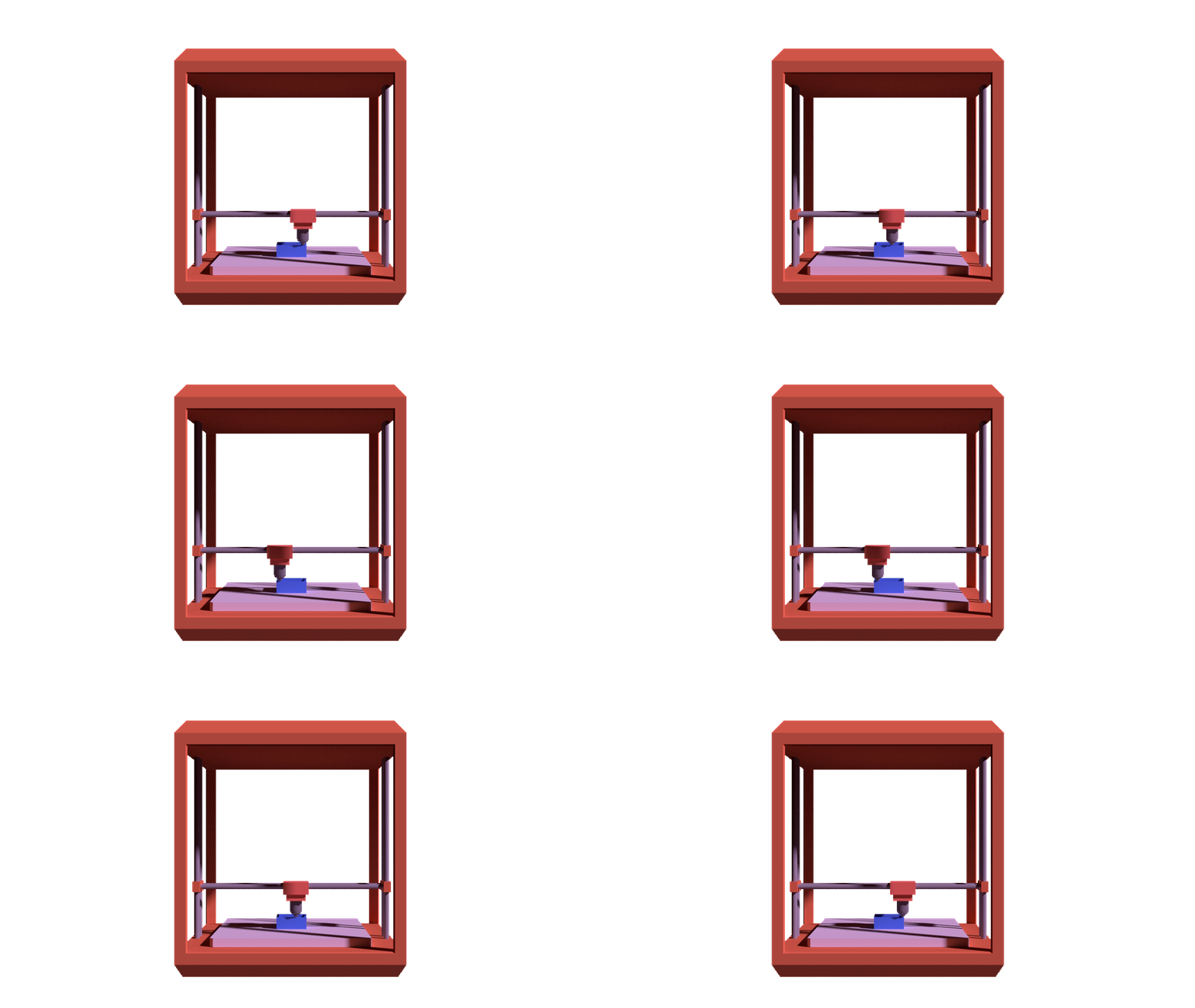
A 3D printer feeds a thin plastic “wire” into a hot metal “extruder” the same way you load glue sticks into the hot glue gun. From there, the machine will squeeze out melted plastic along the profile of a single layer, line by line, based on the settings you want (remember, fully filled in or leave some of it hollow).
The cool part that makes it 3-Dimensional is when one layer is finished, the machine lifts the hot tip up a slightly, and begins another layer on top of the first one. This is repeated over and over until the part is complete.
Who uses it?
In industrial applications you will find engineering teams, product designers, mechanics, architects, and so many more disciplines using 3D printers for what is called rapid prototyping. As it implies, this tool makes it easy to quickly produce prototypes of parts that can be used to see how things fit together, scale parts up or down to see what they look like in real life, or even test out a final manufacturing processes.
For personal applications, people are able to create custom designs to repair objects in their every day life, make toys and fidgets, create wearable costumes and cosplays, and solve other problems that may require a custom solution. The beauty of 3D printing today is that there really is no defining line to say what it can or can’t be used for and people are continuously coming up with novel ideas for things that can be made.
What Now?
It’s currently easier than ever before to purchase your own desktop 3D printer and begin making your own parts in your house. My advice for anyone interested: research into the available printers that are out there and find something you are comfortable spending the money on, and learn everything you can.
If cost is a blocker, many cities have Maker Spaces or local libraries that let people use 3D printers for free, or many schools (elementary through university) will have free resources for students as well! If nothing else, take a shot at watching some videos and reading up on how to 3D print and go spend some time trying to perfect a simple part.
Thanks for taking the time to read, and good luck out there!
 Fuse 3D Ltd.